Architecture
The master specification for vxedge: research goals, topology, vxAPI, manifest schemas, the network, service and virtualization models, methodology, and the phased roadmap.
vxedge is a research-grade orchestration and experiment platform that evaluates 5G network-slice mapping onto zonal and central software-defined-vehicle (SDV) E/E architectures, entirely in software. In short:
- Gateway.
vxgateway, built on the Linux networking stack, replaces physical edge gear. - Zones. KVM/QEMU VMs managed through libvirt provide zonal ECUs (QNX, Zephyr, FreeRTOS, Android Automotive).
- Compute. Containerized central compute runs Autoware/ROS 2 and NVIDIA AD workloads (Alpamayo, DeepStream, TensorRT).
- Control plane. A Rust daemon (
vxedged) orchestrates manifest-driven vehicles, experiments, services and telemetry, and exposes a versioned gRPC/Protobuf API (vxAPI). - Frontends. Thin clients of that API: the
vxedgeCLI today; web/TypeScript and Electron frontends next; and an MCP server (vxmcp) for AI agent tooling. Locally over a Unix socket, or cloud-hosted behind mTLS.
Qt/QML is not an operator-dashboard frontend here; see §5.1 for its two real, unrelated roles: an in-vehicle embedded IVI loadable, and a future vxmodels graphical design tool.
Table of contents
- Executive summary
- Research goals & hypotheses
- High-level architecture (topology & components)
- Repositories & single-source rules
- vxedge control plane & API (vxedged, vxAPI, frontends, CLI)
- Manifests (experiment & vehicle schemas)
- Network model — vxgateway (SDN slicing)
- Service model (OTA, telemetry, extensibility)
- Virtualization & zone provisioning (libvirt, QEMU/KVM, QNX, RTOS, containers)
- Compute model (Autoware/ROS2, Alpamayo, inference, OTA hosting)
- Edge agents & telemetry collection (vxagents / vxtelemetry)
- Experiment methodology, metrics, and analysis plan
- Reproducibility, CI/CD, artifact publication
- Safety, security, licensing, and industrialization notes
- Implementation policy & phased roadmap
- Appendix: example manifests, gateway snippets, run sequence
1 — Executive summary
vxedge is a reproducible, modular framework to define and run SDV experiments that combine zone
virtual ECUs, central compute, a software-defined virtual edge gateway with 5G-style slicing,
and services (OTA, telemetry). Manifests declare the whole system — up to and including a complete
software-bootstrapped vehicle (vxedge vehicle up). The Rust CLI orchestrates the lifecycle
using a simple up|down model across all subsystems.
The platform is designed to:
- generate publishable results (latency/jitter percentiles, OTA reliability, isolation metrics);
- stay production-representative: the same middleware (Eclipse SDV: Kuksa/VSS, Zenoh, uProtocol), network stack (OVS/tc/FRR/WireGuard, SONiC as production NOS twin), and AD workloads (Autoware, NVIDIA Alpamayo) used or converged on by OEMs;
- run on a single NVIDIA GPU host (scaling to several), with an explicit later path onto NVIDIA hardware (Jetson AGX, DRIVE AGX / DRIVE OS, BlueField/DOCA offload);
- be API-first: all orchestration lives behind vxAPI (gRPC/Protobuf) served by the
vxedgeddaemon. The CLI, GUIs (Electron), web dashboards, and thevxmcpMCP server are interchangeable thin clients — human-operated or agent-operated, same rule either way — and the same API hosts locally or in the cloud (controller mode federating multiple hosts).
No physical router is required: the edge-gateway role is fully absorbed by vxgateway.
2 — Research goals & hypotheses
Primary goal: Quantify whether a software-defined virtual gateway — built from the production Linux SDN stack (OVS/Linux bridge, tc queue trees, VXLAN, WireGuard, FRR) and running co-located with virtualized zonal ECUs and central compute — can provide slice isolation and deterministic performance for SDV workloads mapped to logical 5G slices.
Hypotheses to test:
- H1 (isolation): Per-slice VLAN/VXLAN mapping with hierarchical tc queue-tree reservations in vxgateway can keep p95/p99 latency for ADAS (URLLC-like) traffic near baseline under heavy infotainment load.
- H2 (real slicing vs. static mapping): True 5G slicing (S-NSSAI PDU sessions via Open5GS + UERANSIM) provides measurably different — and under contention, stronger — isolation than static VLAN-to-slice mapping.
- H3 (virtualization choice): Virtual ECU packaging (full VM via libvirt vs. container vs. microVM via raw QEMU/QMP or cloud-hypervisor) measurably affects latency/jitter observable at zone-to-compute flows.
- H4 (service co-location): OTA service co-located in central compute (deployed on demand) does not compromise ADAS slice SLAs when slices and queue reservations are correctly configured.
Deliverables: Reproducible experiment artifacts, datasets, scripts, and publishable analysis — plus a reference "vehicle-in-software" composition demonstrating the full stack end to end.
Framing note: unlike physical edge gear, the virtual gateway shares the host with the
workloads it isolates. Determinism controls (PREEMPT_RT kernel, isolcpus, CPU pinning,
hugepages) are part of the method, and their effect is itself reported.
3 — High-level architecture (topology & components)
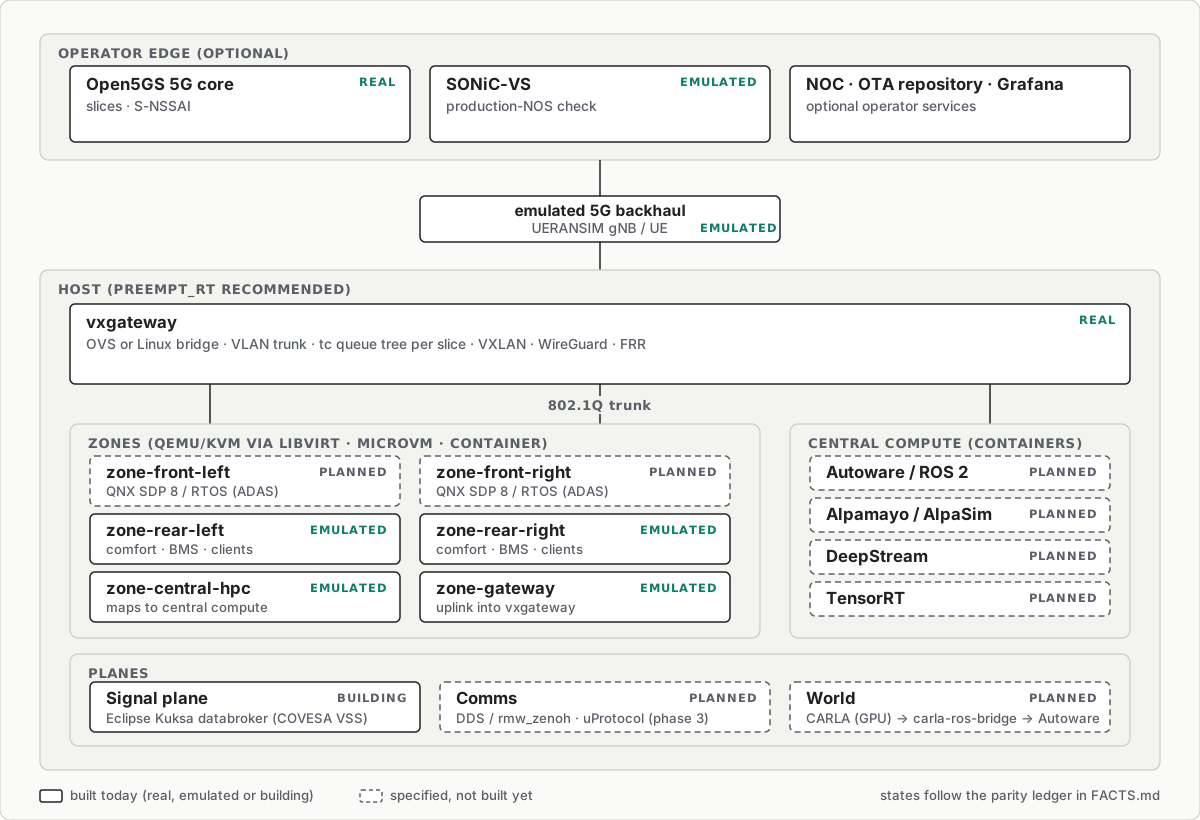
Figure 3.1: the topology (click for full size). Box states follow the parity ledger in FACTS.md: solid is built
today (real, emulated or building), dashed is specified and not built yet. Source:
diagrams/topology.py.
Key components:
- vxedged (Rust) — control-plane daemon: orchestration + provisioning core behind vxAPI (gRPC/Protobuf). See §5.
- vxedge CLI (Rust) — thin vxAPI client; the primary frontend.
- vxgateway — the software-defined edge gateway: Linux-native data plane (OVS or Linux bridge, tc, VXLAN, WireGuard, FRR), provisioned declaratively by the CLI. See §7.
- vxzones — authoritative zone manifests, VM images (QNX SDP 8, Zephyr, FreeRTOS, AAOS), RTOS builds.
- vxcompute — central compute manifests, Autoware/ROS2 images, Alpamayo/AlpaSim, inference.
- vxota — OTA server & signing tooling (artifact store).
- vxagents — performant Rust agents for measurements and metrics.
- vxtelemetry — telemetry ingestion & Prometheus export (VSS-aligned; see §11).
- vxperiments — manifest-driven experiments, vehicle manifests, and results.
4 — Repositories & single-source rules
Canonical repos (under vxedge org):
vxedge/vxedge— Rust workspace:vxedge-core(domain lib),vxedged(daemon, vxAPI),vxedge-cli(thin client),proto/(vxAPI Protobuf IDL — the source for all generated SDKs: Rust/tonic, TypeScript/connect-es), plus gateway provisioning templates (netlink/OVS/nftables/tc, libvirt domain XML templates).vxedge/vxparts— the unified loadable registry: zone VM/kernel/RTOS bundles, central-compute container images, gateway/TCU images, agent binaries, and platform-service images — every loadable the platform boots, published toghcr.io/vxedge/parts/...via OCI/ORAS, classified byclass/subtype/layer(see §13's own artifact-publication rules). Supersedesvxzonesandvxcompute(Track P, decided 2026-07-26): those two repos split loadables by deployment mechanism (VM vs. container) rather than by domain, which is exactly the kind of implementation detail this workspace's own single-source-of-truth discipline exists to keep out of repo topology. Both were archived 2026-08-04 (GitHub archive, not deleted — their history stays reachable, read-only) once their content was confirmed fully present invxparts— seevxparts/TASKS.mdTrack P for the migration account.vxedge/vxota— OTA server, signing, manifests.vxedge/vxagents— Rust agents, metrics exporters.vxedge/vxtelemetry— telemetry ingestion and exporters.vxedge/vxperiments— experiment manifests, vehicle manifests, notebooks, results.vxedge/vxmodels— (track M) SysML v2 system models: requirements/traceability (H1–H4verify-linked to frozen result archives), vehicle structure models, the analysis-case/variant library, and thevxmodelrenderer (Rust) that generates manifests from models. See §6.3 and §15 (track M).vxedge/docs— papers, slides, reproducibility guide.
Single-source rules:
- A zone/compute's manifest is authoritative for its images and node IDs.
- Services declared under
servicesin an experiment manifest are the authoritative runtime descriptors for that experiment (image + config). The code lives in vxota or vxtelemetry as appropriate. - A vehicle manifest is the authoritative composition of zones + compute + network + services for a software-bootstrapped vehicle; experiments reference a vehicle rather than restating it.
- CLI uses manifests as sole input; state stored in ephemeral runtime directories and vxedge logs.
- Exactly two cross-language interfaces exist: manifests (YAML content) and vxAPI
(Protobuf IDL under
vxedge/vxedge/proto/, authoritative; client SDKs are generated, never hand-written). No bespoke ad-hoc RPC. - Model governance (track M, when
vxmodelslands): the SysML v2 model is the design authority upstream of manifests; manifests remain the sole execution contract — the daemon/CLI never read models. A model-rendered manifest records the digest of the model version that produced it and must passvxedge manifest validatelike any hand-written manifest. The model never duplicates what zone/compute manifests are authoritative for (images, node IDs). See §6.3.
5 — vxedge control plane & API (vxedged, vxAPI, frontends, CLI)
Principle (API-first): the split every production SDV toolchain converges on — Tesla-style fleet tooling, NVIDIA DriveWorks tools, AUTOSAR Adaptive development tooling — is a headless core behind a strongly-typed IDL, with every UI a disposable thin client. vxedge adopts it outright: no orchestration logic lives in any frontend.
5.1 Layers & frontends
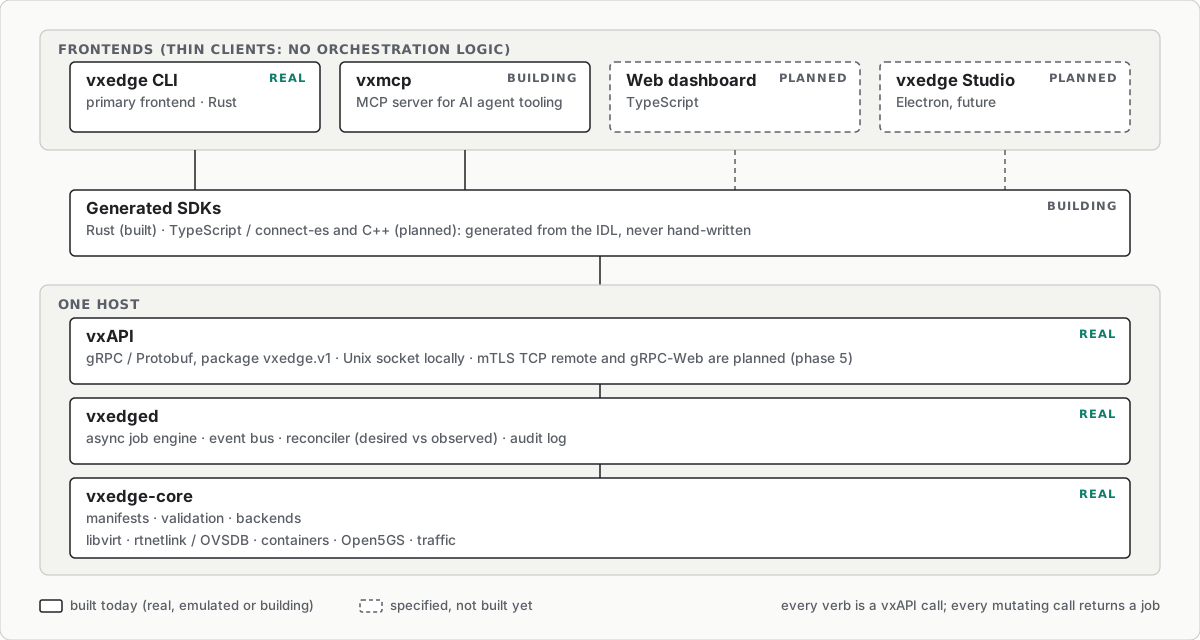
Figure 5.1: layers and frontends (click for full size). Box states follow the parity ledger in FACTS.md.
Source: diagrams/layers.py.
- vxedge-core (Rust lib): pure domain logic; no user-facing I/O.
- vxedged (Rust daemon, tonic + tonic-web): hosts vxAPI. Every mutating verb is an async
job with server-streamed progress; the reconciler compares desired (manifest) vs observed
state — that is what makes
up|downidempotent. - Frontends (all thin clients of the same API): platform administration, live status
monitoring, and experiment operation — for two kinds of operator: OEM engineers and SDV
researchers directly, and (via
vxmcp) AI agent tooling acting on their behalf. None of these are the in-vehicle HMI — that role belongs to Android Automotive (AAOS), already the infotainment zone's guest OS, or an embedded Qt/QML IVI loadable (running under a QEMU ARM zone node or hosted atop QNX — the production pattern several OEMs actually run; both are real, alternate in-vehicle-HMI baselines, §9). Frontends here are external tooling that operates the testbed, not something running inside a simulated vehicle. Correction (2026-08-06): there is no Qt/QML operator dashboard — any platform monitoring dashboard is web-based (TS) or the CLI, never Qt. A separate, future, not-yet-built Qt/QML tool is planned forvxmodels' MBSE tooling (§6.3) — a graphical experiment designer, not an operator dashboard and not a vxAPI frontend the way the items below are.vxedgeCLI (Rust) — unchanged UX; local Unix socket by default,--endpointfor remote; auto-spawns an ephemeral local daemon for single-host lab use.- Web dashboard / Electron (TypeScript; connect-es-generated SDK over gRPC-Web) — cloud console first, "vxedge Studio" desktop app later.
- vxedge-tray (Rust, StatusNotifierItem/SNI system tray) — at-a-glance gateway/experiment state + quick up/down from the desktop; pairs with a systemd unit for vxedged (socket-activated where possible). Same thin-client rule: 1:1 vxAPI calls, no logic.
vxmcp(Rust,rmcp— the official MCP Rust SDK) — an MCP server exposing vxAPI to AI agent tooling (Claude Code and others), for the same reason every frontend above exists: a thin, 1:1 client over the same RPCs, this time addressed by an LLM agent's tool-call surface instead of a terminal or a GUI. Every MCP tool is a direct wrapper over one vxAPI RPC (GatewayService/ZoneService/ComputeService/ExperimentService/TrafficService/SvcService/JobService/EventService) — never a multi-step workflow baked into the server, the hard rule stated explicitly for this frontend too. Sits directly onvxedge-api's generated tonic bindings (a Rust-to-Rust dependency, not a second codegen pipeline the way the TS/C++ SDKs are). Targets MCP spec 2026-07-28: stateless request-response (noinitializehandshake), with Multi Round-Trip Requests (InputRequiredResult/InputRequest::Elicitation) as the mechanism for the one thing a thin wrapper still needs — a mutating tool (up/down/traffic up) asking its caller to confirm before it runs, the same posture a human operator gets from the CLI's own explicit verbs, not something an LLM can chain unsupervised into a destructive sequence. Read tools (status/list/events subscribe/results-archive summaries) ship first, since they carry no such confirmation question and are useful standalone; mutating tools follow once the MRTR confirmation flow is built and reviewed. New repo,vxedge/vxmcp, phase 3 (docs/ROADMAP.md) — frontend/tooling investment, not hardware-gated, so it doesn't wait on anything phase 3's GPU items do.
5.2 API surface (vxAPI, proto/vxedge/v1/)
| Service | RPCs (declarative, manifest-in) |
|---|---|
GatewayService | Apply, Up, Down, Status |
ZoneService / ComputeService | Apply, Up, Down, List, Remove, PushImage (client-streaming) |
SvcService (ota, telemetry) | Up, Down, Status |
VehicleService | Up, Down, Status |
ExperimentService | Up, Down, Status |
TrafficService | Up, Down |
JobService | Get, Watch (server-streamed progress; every mutating RPC returns a Job) |
EventService | Subscribe (state transitions, audit events) |
TelemetryService | StreamMetrics (live), Collect (archive job) |
Rules: mutating RPCs carry manifest documents (or references to them) — the API introduces no
second source of truth beside manifests; daemon state stays in ephemeral runtime dirs + logs.
The proto package is versioned (vxedge.v1): additive changes stay in v1, breaking changes mean
vxedge.v2.
Why gRPC/Protobuf (not SOME/IP, not bare REST): SOME/IP–ara::com is the in-vehicle service
plane — the wrong tool for an orchestration/tooling plane; bare REST lacks first-class streaming
and codegen rigor. One Protobuf IDL generates every SDK, gRPC-Web covers browsers and Electron,
and Protobuf is what Eclipse uProtocol already speaks — schema reuse when the signal plane lands
in phase 3. An optional REST/OpenAPI façade can be added later by transcoding, without touching
the core.
5.3 Transport, security, deployment modes
- Local (default, live today): Unix domain socket only —
vxedged --listenrejects any other scheme outright, andvxedge --endpointrejects any non-unix://value the same way (found while scoping Phase 5, 2026-08-05: neither side has ever accepted anything else). The access boundary today is filesystem permissions on the socket path, not a per-call identity check — noSO_PEERCRED/UCredpeer-credential extraction exists anywhere in the code yet. "Peer-credential auth" below is the target for this mode, not its current behavior; stated honestly here per this doc's own fidelity rule (§14 /testbed-quality) rather than implying it already gates local connections. - Remote (planned, Phase 5): TCP + mTLS, OIDC bearer tokens; roles viewer/operator/admin;
every mutating call audit-logged with the calling actor's identity attached — a second
gap found during the same scoping pass:
Audit::record(rpc, detail)(vxedged/src/audit.rs) has no actor field at all today, because there has only ever been one, local, unauthenticated caller. Remote access without that field would produce an audit log that says what happened but not who did it — not acceptable once "who" is a real question. Full scope:docs/ROADMAP.md's Phase 5 section. - Cloud-hosted (planned, Phase 3):
vxedged --controllerruns anywhere and federates one or more site daemons (one per GPU host, reached over WireGuard + mTLS) behind the same vxAPI. Frontends never know whether they talk to a single host or a fleet controller, and never touch hypervisors directly. A related but distinct concern from Remote access above: federation is site-daemon-to-controller plumbing, not the human/CLI-to-daemon auth path — seedocs/ROADMAP.md's Phase 5 section for why the two are scoped separately.
5.4 CLI — commands & semantics
Location: vxedge/vxedge (Rust workspace: vxedge-core, vxedged, vxedge-cli, proto/).
Binaries: vxedge (thin client), vxedged (daemon).
Global behavior: all lifecycle commands follow up|down semantics. Where staging is required,
up performs staging + start; down stops + cleanup. All operations are idempotent.
Commands (canonical)
# Daemon / control plane
vxedged serve [--listen unix:///run/vxedge.sock | https://0.0.0.0:8443] [--controller]

# Client endpoint (applies to every command below; defaults to the local Unix socket)
vxedge [--endpoint <url>] ...

# Gateway (vxgateway — virtual edge gateway)
vxedge up|down|status

# Zones
vxedge zone up --vxid <vxid>
vxedge zone down --vxid <vxid>
vxedge zone list
vxedge zone add --manifest vxzones/...yaml
vxedge zone rm --vxid <vxid>
vxedge zone image push --vxid <vxid> --from <path> --registry <url?>

# Compute
vxedge compute up --vxid <vxid>
vxedge compute down --vxid <vxid>
vxedge compute add --manifest vxcompute/...yaml
vxedge compute rm --vxid <vxid>
vxedge compute image push --vxid <vxid> --from <path> --registry <url?>

# Services (OTA, telemetry)
vxedge ota up [--experiment <path>]      # cwd-resolved by default, like `experiment up`;
vxedge ota down [--experiment <path>]    # --experiment overrides with an explicit workspace
vxedge telemetry up|down|collect         # not yet wired to the daemon (planned);
                                          # vxtelemetry runs standalone via its own binary today

# Vehicle (software-bootstrapped SDV: gateway + zones + compute + signal plane + services)
vxedge vehicle up --manifest vxperiments/vehicles/<vehicle>.yaml
vxedge vehicle down --manifest vxperiments/vehicles/<vehicle>.yaml
vxedge vehicle status --manifest vxperiments/vehicles/<vehicle>.yaml

# Experiments (manifest-driven; may reference a vehicle manifest)
vxedge experiment up --manifest vxperiments/exp-001.yaml
vxedge experiment down --manifest vxperiments/exp-001.yaml

# Traffic generation
vxedge traffic up --manifest ...
vxedge vehicle up is sugar for the ordered composition: gateway up → zones up → compute up →
signal plane up (Kuksa, phase 3) → services up. vehicle down tears down in reverse.
Every CLI verb is a 1:1 wrapper over a vxAPI RPC — anything the CLI can do, every other frontend (web, Electron, scripts against the TS SDK) can do identically.
6 — Manifests — final schemas (YAML)
6.0 The workspace model (Track D)
An experiment is a folder. Every file declares its kind and id; the loader indexes on
that pair, and every cross-reference is by id, never by path — so files can be renamed or
reorganised without breaking anything.
h1-slice-isolation/
  h1-slice-isolation.vxp   # package descriptor: id, version, entry, requires
  main.yaml                # kind: experiment  — the test
  vehicle.yaml             # kind: vehicle     — the system under test
  road1.yaml               # kind: road        — the environment (omit if unused)
  parts.yaml               # kind: baseline    — which software
  scripts/run.sh           # the campaign: repetitions, warmup, measurement window
  parts/                   # this experiment's own loadables
  assets/                  # scenario files, traces, maps
  tools/                   # analysis specific to this experiment
  results/                 # archives, one per run
A workspace is a sandbox. It owns everything the experiment needs, so it can be zipped,
sent, unzipped and run — which is what makes an experiment shareable at all. A workspace whose
parts live three directories up is not something a recipient can unpack. Only the top-level
*.yaml are workspace documents; the subdirectories are content, and the loader ignores them
(a part.yaml inside parts/ describes a loadable, not an experiment).
Kinds: experiment | vehicle | road | baseline | component. Loading is: read the
.vxp, glob *.yaml (non-recursive, so a results/ archive is never absorbed), index by
(kind, id), resolve references by id. No includes, no import boilerplate, no ordering rules.
Files exist only when the experiment needs them.
A file may hold several documents, ----separated, and a whole workspace may be one file.
That follows from every reference being by id: the file boundary carries no meaning, so it is
free to move. Separate files stay the scaffold default because they teach the model, but an
engineer who wants one file — or a caller with no directory to point at, such as an inline
manifest over vxAPI — has one.
Structure and software are separate files. One vehicle.yaml with many baselines is what
an OTA campaign is, what an RxSWIN identifies, and what makes an A/B arm two baselines rather
than two vehicle files that drift apart.
The vehicle names a slice; the experiment defines it. links[].slice: adas in the vehicle,
network.slices[].mode: vlan|s-nssai in the experiment. H2's comparison is therefore one
block changed over a provably unchanged vehicle, enforced by the schema rather than asserted
in a README. This is the only reference that crosses the structure/test boundary, and
vxedge experiment validate checks it.
network: (and everything under it — slices, tunnels, data_plane, nos_check) lives in
the experiment document only, never inside a vehicle document, for a second reason beyond H2:
there is exactly one vxgateway per experiment run (one bridge, one HTB tree — a deliberate
fidelity choice, one vehicle has one gateway ECU, not an oversight). When an experiment
references multiple vehicles (vehicles: [car1, car2]), they share that one gateway, so they
share one network: block too — a per-vehicle network: would imply each vehicle gets its own
separate gateway, which the system doesn't build. Vehicles that need distinct, isolated
segments still get them: the experiment declares every slice either vehicle needs
(car1-adas/car2-adas on separate VLANs, say), and each vehicle's own links references only
the slice IDs that belong to it — car2.yaml never has to mention car1-adas at all.
Local-first. Every ref has a local form (./images/foo) and a published form
(ghcr.io/… + digest), same key, resolved by shape. digest is optional for local refs
(content-hashed into the results archive) and required for published ones — a moving tag
is not reproducible for anyone else. So a run is always reproducible for its author, and
publishing is what makes it reproducible for others. vxedge experiment up must work
offline with zero published artifacts.
Tooling: vxedge experiment new <id> [--template minimal|slicing] scaffolds a workspace;
vxedge experiment validate [path] runs every cross-file check and reports all problems at
once.
6.0.1 kind: vehicle
kind: vehicle
id: car1
class: road                          # taxonomy spine: kind > class > subtype
subtype: car

zones:                               # REGIONS of the entity, not devices
  front-left: {}
  central: { name: central compute bay, reference: <external zoning std> }

devices:                             # units LOCATED IN zones
  zonefl: { role: zone-controller, zone: front-left, backend: container }
  hpc1:   { role: hpc, zone: central, backend: container, resources: { cpu: 4, memory: 8 } }
  gw1:    { role: gateway, backend: container }

functions:                           # units of BEHAVIOUR, deployed onto devices
  adas:    { deployed_on: zonefl, asil: B }
  percept: { deployed_on: hpc1 }

links:                               # transport: how bytes move (the harness)
  - { id: trunk-fl,  endpoints: [gw1:eth0, zonefl:eth0], slice: adas }
  - id: arm-cont                     # object form, when an attachment needs a fixed address
    endpoints: [{ node: zonefl, port: eth0, ip: 10.101.0.11/24 }]
    slice: adas
  - id: seg-t1                       # a slice-bound link may emulate its PHY
    endpoints: [node-sensor-01:eth0]
    slice: adas
    impairments: { rate_mbps: 100, delay_us: 250, jitter_us: 40, loss_pct: 0.01 }
    harness: { medium: 100BASE-T1, length_m: 2.4, weight_g: 85 }

channels:                            # interaction: what is exchanged, between FUNCTIONS
  - id: adas.object-list
    from: percept
    to:   [adas]
    protocol: dds | zenoh | someip | udp
    qos: { reliability: reliable, deadline_ms: 50 }
    carried_by: [trunk-hpc, trunk-fl]
Zone, device, function are three different things. A zone is a place — a named region
(front-left, cabin, nacelle-2, an ATA zone), not an enum, which is what lets a non-road entity
have zones at all. A device is a unit located in one. A function is behaviour deployed onto a
device: AUTOSAR calls it a software component, and separating it from the ECU it runs on is the
whole point of the Virtual Function Bus. parts: targets functions, and channels connect
functions — a topic flows between behaviours, and which devices they sit on is a deployment
decision a study should be able to vary without rewriting the interaction topology.
role is zone-controller | hpc | gateway | ecu | sensor | actuator | switch. backend is
container | qemu-microvm | libvirt and is required for any device attached to a slice:
the planner has to know whether to build a veth or a tap, and guessing produced a workspace
that validated and then could not boot.
Addressing is <id>[:<port>]. Ids are flat and unique workspace-wide (zonefl, not
zones.front-left): structural paths break when the model is restructured, and flat ids do
not. Uniqueness is an enforced check, and so is the zone/device collision it makes possible.
A link endpoint takes two forms. The bare zonefl:eth0 is right whenever nothing has to be
reachable at a known address, which is most attachments. The object form
{ node, port, ip } pins a host address on that attachment, for the case with no other
expression: exp-002's three arms share one VLAN and are told apart only by address. An
address belongs to the attachment rather than the device — a device on two slices has two — and
it lives in the vehicle rather than the experiment because it states a structural fact ("this
ECU answers here"), which is what keeps one vehicle usable by many baselines.
carried_by binds a channel to the links carrying it, and validation requires the channel's
endpoints to be genuinely reachable over those links. This is what makes latency and loss
attributable per topic per slice rather than only per link — the measurement §12 exists to
produce. Without the reachability check, carried_by would be an unchecked assertion.
A slice-bound link may add impairments (tc netem: rate_mbps/delay_us/jitter_us/
loss_pct) to emulate the PHY it stands for — the mechanism behind §7's "Harness modeling."
Every value is per traversal, one direction: a round trip pays the declared delay twice. Exactly
one of the link's access ports renders it, in both directions (the reverse direction rides an
IFB, since a qdisc only shapes egress); which port is not observable in a measurement, only that
the segment's declared characteristics apply once per crossing. Any link, impaired or not, may
separately carry harness (medium, length_m, weight_g) — the declarative record a
zonal-versus-domain harness-reduction study reports on, distinct from impairments' emulated
half: nothing about a length in meters is a tc argument.
Behaviour splits in two: interaction (channels) belongs to the vehicle; stimulus
(traffic_profiles, scenario) belongs to the experiment and the road. The vehicle is the same
vehicle whether it is driven hard or gently.
6.0.2 kind: baseline
kind: baseline
id: bl-2026-07
rxswin: RX-VXE-0001-0003             # optional; UN R156, a property of the vehicle TYPE

parts:
  - ref: ghcr.io/vxedge/parts/zone/qnx/os/sdp8-base:1.0.0
    digest: sha256:…                 # required for published refs
    target_ids: [zonefl, zonefr]     # scalar or list — declared once, however many nodes
  - ref: ./images/my-autoware        # local; no digest required
    target_ids: hpc1
Each entry carries ref, digest, target_ids, and — only where the reference is silent
about it — kind: container | bundle. Class, subtype, layer, name and the VXPN part number are
all derivable from the ref path; restating them is the drift the computed-part-number design
exists to prevent.
kind exists because a part knows what it is and a device knows how it is run, and the two
have to agree: a container backend boots a container image, libvirt and qemu-microvm boot a
guest bundle. The local/… namespace is conclusive on its own (a host process, never a
bundle), and a published vxparts ref is deliberately not read for this — its class says
what kind of node the part loads onto, not how it is packaged, and a zone guest is legitimately
a container under the netns backend. Only a bare path is genuinely ambiguous, and there kind
is how the author says so. A stated kind is validated against the device's backend, so a
baseline pointing an H3 libvirt arm at a container image is rejected with both halves named
rather than silently accepted and failed at boot. vxedge manifest bom derives them for display,
SBOM export and the RxSWIN roll-up.
target_ids declared once for many components is deliberate: repeating a shared part
per-component is how fleet baselines silently drift when one copy is bumped and the others are
not.
6.0.3 kind: experiment and the .vxp descriptor
kind: experiment carries network (slices, tunnels, nos_check), traffic_profiles,
telemetry, services and results, plus vehicles: [<id>…], baseline: <id>, world: <id>,
and a method block (duration_s, repetitions, warmup_s). It carries no zones/compute
inline: structure is the vehicle's, and software is the baseline's.
Every one of those blocks is typed and validated when the model is built — a malformed
services: entry is one error against the file the author wrote, not a surprise at svc up.
network.tunnels (docs/ROADMAP.md #16) declares a point-to-point link the gateway itself
terminates, reaching a remote peer (another site's gateway) — distinct from network.slices,
which partitions the local bridge fabric zone nodes attach to. Two kinds today, each with only
the fields it needs:
network:
  tunnels:
    - id: ota-uplink
      kind: wireguard                  # an encrypted, routed L3 endpoint
      listen_port: 51820
      address: 10.200.0.1/24           # this side's address on the tunnel's own overlay subnet
      peer:
        public_key: <base64>           # the peer's key, known out of band — never this side's own
        endpoint: 198.51.100.7:51820   # omit if this side only listens (WireGuard roaming)
        allowed_ips: [10.200.0.0/24]
    - id: site-b-adas
      kind: vxlan                      # extends a local slice's L2 domain across hosts
      vni: 100                         # 24-bit VXLAN network identifier
      remote: 198.51.100.7             # the remote gateway's reachable address (bare IP)
      dstport: 4789                    # optional; defaults to the IANA-assigned VXLAN port
      slices: [adas]                   # which of this experiment's own slices this link carries
wireguard carries no local key material, deliberately: a manifest is a versioned document, and
a private key does not belong in one. The gateway mints its own identity on first up — piped
straight from wg genkey into wg set's stdin, never written to disk — and vxedge status
reports the resulting public key back, which is what an operator hands to the peer out of band.
Re-applying an already-existing tunnel reconfigures its peer/listen-port declaratively without
touching that identity, so a routine reconcile pass can never silently invalidate what the peer
already trusts.
vxlan has no key material at all — an unencrypted L2 extension, the same trust model as a
physical inter-switch link — and is structurally the opposite of wireguard: a WireGuard
interface is a routed L3 endpoint, never enslaved to the bridge/OVS switch, while a VXLAN
interface joins the bridge as a trunk-like port, so slices (not an address/peer block)
is what a vxlan tunnel actually needs — which local slice(s) it extends, validated against
network.slices the same way a links[].slice reference is. Model and validation only
(docs/ROADMAP.md #16, delivered 2026-08-04) — GatewayPlan refuses to plan a kind: vxlan
tunnel today (PlanError::VxlanTunnelNotYetProvisionable), loudly rather than silently
dropping it, since provisioning it is a separate, not-yet-built follow-on.
network.nos_check (docs/ROADMAP.md #16/#31, schema settled 2026-08-04) opts an experiment
into checking its network.slices VLAN intent against a real production network OS, alongside
— never instead of — the actual measured path (network.data_plane). Absent by default; most
experiments don't declare it:
network:
  nos_check:
    kind: sonic-vs                     # the only kind today
    trunk_port: Ethernet0              # validated against the pinned image's actual port list
    # part_ref / digest: optional, default to the pinned build vxparts/parts/gw/nos/os/sonic-vs
Deliberately not named "twin": the whole testbed already is one (an executable virtual
prototype of a vehicle), so reusing that word for one internal field would describe nothing.
What this does is a check — boot a real instance of the named NOS, hand it the same VLAN
declaration network.slices already expresses, and confirm it accepts and reports back exactly
that. It never carries measured traffic (§7: SONiC-VS is functional but not
timing-representative), and it is not part of experiment up's provisioning sequence — a
missing or misconfigured nos_check block never blocks or changes what an experiment actually
measures.
kind names which NOS is being checked against — sonic-vs today, the shape a second kind
would extend rather than a reason to design one now (network.data_plane's own
kernel-bridge | ovs precedent). trunk_port is not a name vxedge invents: it is one of the
pinned image's own, fixed port names (SONiC-VS's default reference platform exposes exactly 32,
Ethernet0/Ethernet4/.../Ethernet124 — confirmed by booting it, not assumed), validated at
vxedge experiment validate time against that concrete list rather than a free-form string or a
loose pattern.
The .vxp descriptor holds packaging rather than content, so a version bump never touches an
experiment file:
id: h1-slice-isolation
version: 0.1.0
entry: main.yaml
requires: { gpu: none }              # surfaced at scaffold time, checked by validate
6.0.4 Requirements vs. allocation
Two different things that both sound like "resources":
requireson a part (part.yamlinvxparts) — what the software needs:arch,libc,cpu,memory_gb,gpu.vram_gb,gpu.compute_capability.resourceson a component (in a vehicle) — what the node is allocated.
vxedge manifest validate checks part → component → host and fails early, so "this host
cannot run this workspace" is reported before build time is spent rather than after.
depends_on between parts is metadata only: validated for presence in the same baseline,
never version-solved — a resolver is a package manager, and that would be a separate,
deliberate decision.
6.0.5 Interface naming
A device's host interfaces are derived from its id: vz-<stem> for the bridge access port
(the veth host side, or the tap itself) and vzp-<stem> for the veth peer. The stem is the
sanitised id, shortened to a readable head plus a hash of the whole id when it does not fit the
kernel's 15-byte IFNAMSIZ limit — node-cont-01 becomes vz-node-c-32cc.
This is a contract, not an implementation detail: campaign scripts address these names directly
(ip addr replace … dev vzp-node-a-c06a, qemu … ifname=vz-node-q-691e). Names used to be
positional — vz0, vz1, … in traversal order — which made ordering load-bearing in the
worst way: adding a device renumbered the rest, and two views of the same topology could
number it differently. exp-002 declares its arms cont, microvm, libvirt and sorts to cont, libvirt, microvm, so two H3 arms swapped interfaces between the two schema paths — the
campaign would have measured libvirt and reported microvm, passing every test on the way.
A name now depends on its own device and nothing else: not declaration order, not sorting, not
how many other devices exist. Two ids that shorten to one name are refused with both named.
vxedge zone list prints each device's port= and peer=, so the mapping is always
answerable without recomputing a hash.
6.0.6 Migration status
§6.0 is the only authored schema, and the only runnable one (2026-07-31). Every planner
takes the domain model, which is built from a workspace; vxedge up, vxedge experiment up
and vxtelemetry ingest|collect all read a workspace directory. All five experiments —
exp-001, exp-002, exp-002b, exp-003, exp-010 — have workspaces, each verified to produce
plans identical to the frozen §6.1 manifest it replaced.
§6.1 and §6.2 are deleted — structs, adapter and lowering alike. vxmodel render (track M)
emits workspaces too, so vxedge manifest validate has one shape to check and CI asserts it.
The frozen vxperiments/experiments/exp-*.yaml files are kept as provenance for the results
already recorded against them, not as inputs. Pointing a tool at one now reports what the
document is and where to go instead.
6.1–6.2 Experiment and vehicle manifests — retired 2026-07-31
These two schemas are gone: the structs are deleted from vxedge-core, nothing parses them, and
no tool emits them. §6.0 is the only schema.
They are named here rather than silently dropped because results archives, RESULTS.md entries
and the frozen vxperiments/experiments/exp-*.yaml files all reference them. A §6.1 experiment
manifest was one document carrying experiment/network/zones/compute/links/
traffic_profiles/telemetry/results, with software attached to a node as a flat image:;
a §6.2 vehicle manifest carried the same composition blocks under a vehicle: header. §6.0
splits both across kind: experiment / kind: vehicle / kind: baseline documents and
separates zone (a place) from device (a unit) from function (behaviour) — the conflation that
made channels unexecutable and a slice's definition unlocatable.
The frozen manifests stay in vxperiments/experiments/ as provenance for results recorded
against them. To read one against the schema it was written to, use the v0.1.0 tag, which is
where phase-1 reproducibility is anchored.
6.3 Model governance — SysML v2 (track M, vxmodels)
Why SysML v2 here: unlike v1 it is textual (git-diffable), has a standardized REST/JSON API,
and composes typed elements — the first systems-modeling standard practical for GenAI
authoring. vxedge is unusually well-placed for it: the system is already fully declarative
(manifests) and fully executable (up|down), so a model layer is live, not documentation.
Construct mapping (authoritative for track M):
| SysML v2 construct | vxedge artifact |
|---|---|
requirement def + verify | hypotheses (H1–H4, then per-experiment) → frozen result archives |
part / connection / interface defs | vehicle manifest: zones/nodes, links harness, slices + QoS |
analysis case + variant points | experiment manifest + its arms |
use case / occurrence | traffic/transportation scenarios (CARLA; ASAM OpenSCENARIO alignment) |
| metadata annotations | fidelity ledger: per-part caveats → per-experiment validity envelope |
Pipeline: .sysml sources (authored in vxmodels) → vxmodel render (Rust) → YAML
manifest (+ recorded model digest) → vxedge manifest validate --json → the normal CLI
lifecycle. GenAI-authored experiments therefore clear two typed gates (model typing,
then manifest validation) before touching the testbed — the safety argument for generated
experiments is structural, not aspirational.
Out of model scope, by rule: Rust internals, the vxAPI IDL (Protobuf stays the contract, SDKs stay generated), and anything zone/compute manifests are authoritative for.
Future graphical frontend (not yet built, added 2026-08-06): a Qt/QML desktop tool —
analogous to the planned Electron "vxedge Studio," an MBSE/CAD-style variant of the same idea —
to help OEM engineers design experiments visually instead of hand-authoring .sysml text
directly. It would still read/write the same textual, git-diffable .sysml sources (the
construct-mapping table above stays the contract either way); a graphical editor is a view onto
that source, not a second model format. Explicitly deferred — no design work done here yet.
Terminology (matches ROADMAP.md): track M makes vxedge a model-governed executable
virtual prototype. "Digital twin" is an earned claim reserved for phase-4 hardware parity
— track M supplies the model half; phase 4 supplies the physical half.
7 — Network model — vxgateway (SDN slicing)
The edge gateway is a virtual network function built entirely from the production open-source
Linux SDN stack, provisioned declaratively by vxedge (Rust rtnetlink/OVSDB, no shell
templating):
- Data plane: Open vSwitch (or Linux bridge) carrying an 802.1q trunk; one VLAN per slice. Deployed either as a set of network namespaces on the host (default; lowest overhead, fully inspectable) or as a dedicated VM (stronger isolation of the gateway itself).
- Queueing / slice QoS: hierarchical tc (HTB) queue trees per slice with guaranteed min-rate for URLLC-like slices — the object of hypothesis H1.
- Real 5G slicing (H2): Open5GS core + UERANSIM gNB/UE terminate PDU sessions per S-NSSAI;
slice definitions in the manifest (
mode: s-nssai) provision both the 5G core and the gateway. Zone nodes may additionally carry a URSP-styleslice_policy(per-traffic-class selection across concurrent PDU sessions), mirroring UE-side slicing as deployed on production automotive modems (Qualcomm Snapdragon Auto 5G; cf. the DT/BMW/Valeo/Ericsson/Qualcomm 5G SA slicing trial, which vxedge reproduces openly in software). Optional radio-channel realism via NVIDIA Sionna (6G Developer Program); full Aerial CUDA-Accelerated RAN is a stretch goal requiring specific NVIDIA platforms. - TSN variant (phase 3): time-aware scheduling via
taprio/cbsqdiscs + gPTP time sync (linuxptp, 802.1AS) as an alternative gateway shaping mode — enables HTB-vs-TSN isolation comparisons matching production automotive Ethernet backbones. - Legacy bus edges (
type: can, phase 3): SocketCAN/vcan buses per zone, exposed to guests via QEMU CAN controllers and tunneled across the backbone with cannelloni; CAN frames map to VSS signals via Kuksa feeders — the zonal-controller CAN-aggregation role that makes the prototype vehicle-shaped rather than datacenter-shaped. - Harness modeling: the manifest
linkssection is the wiring harness. Per-linkimpairments(tc netem: rate cap, latency/jitter, loss) emulate PHY characteristics such as 100/1000BASE-T1 — delivered: rendered onto the elected access port's egress qdisc and, for the reverse direction, an IFB the port's ingress traffic is redirected onto (a qdisc only shapes egress, so the return direction needs a device of its own to shape).harness(medium/length_m/weight_g) carries the same segment's physical properties declaratively, for a harness-reduction report, independent of whether it is impaired. CAN/LIN drops ridetype: canlinks (LIN modeled as a constrained bus, phase 3). Because harness topology is manifest data, it becomes an experimental variable — star vs daisy-chained zones, sensor-to-ECU path placement — iterable in minutes, which no physical testbed offers. Power distribution is modeled only as VSS signals (vxplant power tree, optional); electrical/thermal fidelity is explicitly out of scope. gPTP/TSN (above) is the harness's timing layer. - Tunnels: VXLAN for inter-host communication; WireGuard (in-kernel) for secure telemetry and
OTA transport —
network.tunnels(§6.0.3), one gateway-terminated point-to-point link per entry. WireGuard delivered (docs/ROADMAP.md#16): backend-independent (a WireGuard interface is a routed L3 endpoint, never enslaved to the bridge/OVS switch — the same mechanism regardless ofnetwork.data_plane). No local key material in the manifest; the gateway mints its own identity on firstupand reports the public key back viastatus. Kernel-level correctness (a real handshake between two simulated hosts, not just interface presence) verified bygateway_netns.rs'stunnel_completes_a_real_handshake_between_two_simulated_hosts. VXLAN: model and validation delivered 2026-08-04 (docs/ROADMAP.md#16) —kind: vxlan(§6.0.3), structurally the opposite of WireGuard: it joins the bridge as a trunk-like port, extending one or more local slices' L2 domain across hosts.GatewayPlanprovisioning is a separate, not-yet-built follow-on; declaring one today is refused loudly at plan time, not silently dropped. - Routing: static for lab experiments; FRR provides BGP for cloud interconnect.
- Firewalling: nftables per VLAN/slice.
- Production NOS twin: the same slice/VLAN/VXLAN/BGP intent is also rendered onto a
SONiC-VS virtual switch (community qcow2). SONiC is the production open-source NOS
(Linux Foundation; NVIDIA ships production SONiC on Spectrum), which demonstrates that vxedge
slice configs express identically on a production NOS. The SONiC-VS data plane is functional
but not timing-representative, so all latency/jitter measurements run against the
Linux-native vxgateway path. (NVIDIA Cumulus VX is deprecated as a standalone image and is not
used; NVIDIA Air remains only an optional cloud sandbox.) Manifest field:
network.nos_check(§6.0.3). - Determinism controls: gateway forwarding cores pinned and isolated (
isolcpus), PREEMPT_RT host kernel, hugepages. An optional FD.io VPP (DPDK) data-plane variant exists for URLLC-focused runs needing minimal per-packet latency variance. - Hardware offload path (phase 4): the same OVS/tc intent offloads onto NVIDIA BlueField DPU / ConnectX via DOCA — the production exit ramp from the virtual gateway.
- Monitoring: gateway counters, tc/OVS statistics, and syslog exported to the central Prometheus node.
8 — Service model (OTA, telemetry, extensibility)
- All services defined under top-level
servicesin the manifest. otaandtelemetryare the core supported types.- Services can be referenced in
zonesorcomputenodes. - CLI deploys services via
vxedge ota up|down [--experiment <path>](cwd-resolved by default), or as part ofexperiment up --stage services— the path an actual campaign takes, since it sequences services after the gateway/zones they depend on. - Extensible: future
vxsvc-*repos can be added and referenced in manifests. The phase-3 Kuksa databroker (vehicle signal plane, COVESA VSS) is deployed via the vehicle manifest'ssignal_planeblock rather than as an experiment service. - Each service definition includes
id,type,image,config.
OTA design (H4, vxota): the service exists to be a realistic, measurable OTA
workload for H4, not a fleet-management platform — two industry concerns are kept
deliberately separate:
- Trust model (adopted as design vocabulary, not as a dependency): artifact metadata follows the shape of Uptane (the automotive-specific, TUF-derived OTA security framework — the closest thing to an ISO/SAE 21434 / UNECE R156-aligned standard) — signed root/targets-style manifests, image-repo vs. director-repo separation. The reference implementation aktualizr (C++) is not adopted as a dependency: it would contradict the Rust-first service policy (§15) for no benefit vxota needs today.
- Delivery/orchestration (out of scope for vxota v1): production fleet tools —
Eclipse hawkBit (Java rollout server + DDI API) and Mender (Go, server+client)
— are named here only as the production analogs an OEM engineer would recognize
(mapped in
docs/USER-GUIDE.md§6); neither is wired in, since vxota's zones/compute nodes are ephemeral per-experiment instances, not persistent fleet devices needing campaign/rollout management. - Slot/image-swap updates (phase 3, optional): if a later experiment wants a real atomic image swap on a running zone (vs. vxota v1's signed-blob delivery), the candidate is Rugix Ctrl (Rust, memory-safe, secure-by-default signature verification, native content-defined-chunking delta updates — chosen over the more established RAUC specifically for the Rust-policy fit; RAUC remains the fallback if Rugix's narrower deployment history or its gaps — no NAND/UBI, no encrypted updates, both irrelevant to our QEMU/libvirt block-storage bundles — become a blocker). Maps naturally onto vxzones guest bundles, which are already kernel+initramfs "slots" in Rugix/RAUC's sense.
- v1 service backend (fidelity caveat, stated honestly):
SvcService.Up(§5) spawns the service binary (vxota serve) as a host-local child process co-located withvxedged, tracked by a pidfile the same way the microVM zone backend tracks QEMU — not yet scheduled onto avxcomputenode, since that backend doesn't exist.config.listen(new manifest field, alongsideconfig.artifacts) is the address the process binds; today that is still the gateway's own bridge address on the slice under test, an address zone nodes can already reach without a tunnel.network.tunnels(§7) now exists as a mechanism — a manifest can declare a WireGuard link the gateway terminates — butvxotais not yet wired to bindconfig.listenonto one; that integration, and scheduling onto a realvxcomputenode, remain open (vxedge/TASKS.md§4).
9 — Virtualization & zone provisioning (libvirt, QEMU/KVM, QNX, RTOS, containers)
Stack, bottom to top: host Linux (PREEMPT_RT, isolcpus, hugepages) → KVM → QEMU — managed by
libvirt, driven by vxedge through the Rust virt crate.
- libvirt is the default zone backend for
kind: vm | rtimage. The CLI compiles zone manifests into libvirt domain XML: lifecycle (define/start/destroy/undefine) gives idempotentup|downand queryablestatus; vNICs attach to the vxgateway OVS/bridge trunk with per-vNIC VLAN tags;<cputune>(vcpupin/emulatorpin), hugepages, and virtio multiqueue express the manifest'srealtime:block; storage pools hold the SHA256-digest-tagged images. - microVM escape hatch:
backend: qemu-microvmdrives raw QEMU (QMP,microvmmachine type) — or cloud-hypervisor/Firecracker — bypassing libvirt's device model for the minimal-latency arm of hypothesis H3. Both backends hide behind the samevxedge zone upinterface. - Guest palette:
- QNX SDP 8 (free non-commercial license) — QEMU x86-64/ARM guest; the
production-representative ADAS/safety guest for
front-left/front-rightzones. QNX is what production ADAS and cockpit controllers run, which anchors OEM relevance. - Zephyr / FreeRTOS — microVM images for sensor/ECU nodes.
- Android Automotive (AAOS) — infotainment zone; QEMU with virtio-gpu or GPU passthrough.
- Embedded Qt/QML IVI/cluster loadable — an alternate infotainment/cluster baseline to
AAOS, not desktop tooling (correction, 2026-08-06: earlier drafts of this document
wrongly scoped Qt/QML as an operator dashboard only — it has no such role, see §5.1). Runs
either as an app/middleware layer atop the QNX guest above (the production QNX+Qt
cluster/IVI pattern several OEMs actually ship) or under a bare QEMU ARM zone node —
exercises the same "one vehicle, many baselines" mechanism (
ARCHITECTURE.md§6.0) that lets an experiment swap AAOS for Qt/QML (or vice versa) on the same infotainment zone without touching the vehicle's structural definition. - Containers — for nodes where packaging as a container is the experimental variable.
- QNX SDP 8 (free non-commercial license) — QEMU x86-64/ARM guest; the
production-representative ADAS/safety guest for
- Fidelity caveat (stated honestly in publications): production zonal controllers invert this stacking — silicon runs a Type-1 hypervisor (QNX Hypervisor and peers) hosting guests, whereas here KVM plays the hypervisor and QNX is a guest. Functionally equivalent for slice-isolation research; the gap closes via the hypervisor fidelity ladder below and, ultimately, DRIVE OS on DRIVE AGX hardware (phase 4).
- Hypervisor fidelity ladder (production-grade rungs only — no research-toy hypervisors):
- Rung 0 (software-only, phase 1–3): KVM with strict static partitioning — isolcpus/cpuset pinned cells, hugepages — the Linux approximation of partitioning and the baseline arm of the freedom-from-interference experiment (exp-004).
- Rung 1 (phase 4): Xen dom0less as a dedicated boot-entry host profile — production open-source with an active functional-safety track (Xen 4.21 dom0less refactoring; AMD/Honda automotive demos, Xen Summit 2025); Zephyr domUs boot sub-second.
- Rung 2 (phase 4): QNX Hypervisor — the production zonal-controller stack itself (license permitting; pairs with DRIVE OS QNX). Each rung converts part of the stated caveat into a measured claim (exp-004 reruns per rung).
- CLI stages images, creates instances, and configures network interfaces; persistent storage optional per zone; logs and telemetry collected centrally.
Sensor, actuator & I/O virtualization (four layers)
- Perception sensors (camera, lidar, radar, GNSS/IMU) — synthesized by the world
simulator (CARLA; AlpaSim / Sensor RTX as the higher-fidelity path). In a real vehicle
these ride GMSL/FPD-Link serdes into the ADAS ECU; here the transport is slice traffic
through vxgateway (
traffic_profiles.source: carla) — sensor streams are the measured ADAS load, not synthetic filler. - Body sensors/actuators (doors, HVAC, wipers, BMS…) — restbus simulation: simulated
nodes emit/consume CAN frames per DBC definitions (
sensors:/actuators:in the node schema); Kuksa's CAN provider maps DBC signals ↔ VSS. Closed-loop behavior comes from the vxplant agent (invxagents): subscribes to actuator commands, integrates a plant model (first-order default; FMI/FMU import in phase 4 so OEMs can drop in Simulink-exported models), publishes sensor feedback. - Register-level I/O (GPIO/ADC/PWM/I2C/SPI) — application-class ECUs (QNX, AAOS) use QEMU
device models (
io.devices); MCU-class ECUs needing register fidelity use Renode (backend: renode): full peripheral models running unmodified Zephyr/FreeRTOS firmware. - Actuation loop closure — control commands (steering/throttle/brake) return to CARLA via carla-ros-bridge vehicle control, closing the loop world → sensors → slices → AD stack → actuation → world. End-to-end control-loop latency under slice contention is a first-class metric (§12).
Boundary standards (phase 4): ASAM OSI at the simulator↔stack boundary, FMI/FMU for plant models, XIL-style semantics for the bench API — so the virtual testbed and OEM HIL rigs speak the same protocols (the SIL→HIL migration story).
10 — Compute model (vxcompute — Autoware/ROS2, Alpamayo, inference, OTA hosting)
- Compute nodes run containerized workloads. Two AD stacks are supported as ADAS-slice workloads,
which usefully stress the network differently:
- Autoware / ROS2 (Apache-2.0) — classical modular AV stack; consumes CARLA sensor streams via carla-ros-bridge.
- NVIDIA Alpamayo / AlpaSim (open-sourced at CES 2026) — reasoning-VLA driving model and open simulation framework; runs on the host GPU without DRIVE hardware. Fine-tuning and DRIVE Hyperion integration are out of scope (phase 4).
- Perception/inference workloads use DeepStream / TensorRT; container definitions are
optimized for GPU pass-through and TensorRT runtime (see
resources.gpuin the schema). - OTA server may be deployed in a compute node if referenced in the experiment manifest.
- Resources declared in manifest (
cpu,memory,gpu); services deployed dynamically per manifest references. - Optional in-vehicle-style workload orchestration via Eclipse Ankaios/BlueChi (phase 3) to mirror production SDV runtimes.
11 — Edge agents & telemetry collection (vxagents / vxtelemetry)
- Rust agents deployed per experiment to collect metrics, latency, and traffic.
- Prometheus exporters for centralized metric collection; GPU metrics tracked alongside (DCGM/NVML: utilization, VRAM boundaries, thermal/power throttling) since AD workloads share the host with the gateway.
- VSS alignment: vehicle-signal telemetry follows the COVESA VSS catalog via the Kuksa databroker (phase 3). The open-source C++ AWS IoT FleetWise edge agent serves as a design reference for signal collection/campaign semantics — as a reference only: the AWS-hosted FleetWise service closes to new customers in April 2026 and is not a dependency.
- Optional PCAP capture for detailed traffic analysis.
- Agents and telemetry services configured via manifest and CLI commands.
- Designed to be lightweight to avoid perturbing experiment results.
12 — Experiment methodology, metrics, and analysis plan
Methodology:
-
Preparation:
- Validate manifest syntax and semantics (experiment + referenced vehicle manifest).
- Stage images on host(s) using CLI (libvirt storage pools / container registry).
vxedge upprovisions vxgateway slices (VLANs, tc queue trees; S-NSSAI slices in the 5G core formode: s-nssai).
-
Execution:
vxedge vehicle up(orvxedge experiment upreferencing a vehicle) to provision gateway, zones, compute, signal plane, and services.- Generate traffic per
traffic_profiles— synthetic (pps/bandwidth) and/or real perception traffic (source: carla). - Collect telemetry (Prometheus + GPU metrics + PCAP) and service logs.
-
Postprocessing:
- Extract metrics from Prometheus exporters.
- Parse PCAPs for latency, jitter, packet loss.
- Aggregate results per slice and per node.
Metrics:
- Network: p50/p95/p99 latency, jitter, packet loss per slice.
- Closed loop (phase 2+): end-to-end control-loop latency — world → sensors → slices → AD stack → actuation → world — under slice contention.
- Compute: CPU/memory/GPU utilization, service response times.
- OTA: deployment success rate, artifact delivery latency.
- Telemetry agents: data ingestion rates, metric completeness.
Analysis plan:
- Compare latency/jitter under different virtualization choices (H3: libvirt VM vs container vs microVM).
- Evaluate slice isolation under heavy multi-zone traffic (H1), and static VLAN mapping vs real S-NSSAI slicing (H2).
- Quantify OTA and telemetry impact on URLLC slices (H4).
- Quantify the effect of determinism controls (pinning, PREEMPT_RT, VPP data plane) on tail latency.
- Generate reproducible tables, charts, and CSV datasets for publication.
13 — Reproducibility, CI/CD, artifact publication (registries)
-
Workspace identity — one rule. A run's provenance is a SHA-256 over every file the experiment is made of: the relative path, a NUL, the bytes, a NUL, in sorted path order, recursing into subdirectories and excluding
results/.Each part of that is load-bearing. The path is hashed with the bytes, so renaming a file is a change. Order is sorted rather than as-read, so the answer does not depend on the filesystem.
results/is excluded because outputs are not inputs — including them would change a run's identity the moment it produced one. The recursion is what distinguishes the identity from the document set: a sandbox'sparts/,assets/,scripts/andtools/are what ran even though they are not workspace documents, and a local part that changes is a different experiment.It answers one question — did every repetition of this campaign run from the same input? — and it is one rule because it is recorded in two places that must agree: the daemon's audit records and the results archive's
workspace_sha256.vxedge-coreandvxtelemetryimplement it independently (the latter deliberately does not depend on the former) and pin the same test vector over the same fixture. Two implementations of one rule stay honest by agreeing on an answer, not by sharing code; if the rule is revised, both move together. -
Reproducibility:
- All manifests under
vxperimentsare versioned and authoritative. - Images and RTOS builds tagged with SHA256 digest.
- CLI ensures idempotent
up|downoperations (libvirt domain lifecycle; declarative gateway provisioning). - Because the gateway is software, its full provisioning is unit/integration-testable in CI against network namespaces — no physical router in the loop.
- All manifests under
-
CI/CD:
- GitHub Actions pipelines for building images, testing CLI, and publishing manifests.
- Artifacts automatically uploaded to private registry or S3 bucket.
- Experimental runs can be triggered and reproduced on demand.
-
Artifact publication:
- Results archived per
results_prefixin experiment manifest. - Metadata includes experiment ID, workspace identity (above),
.vxpid/version, CLI version, and — when the campaign opts in — the content-addressed digests of the container images it ran against. The archive bundles the workspace itself underworkspace/, so a result is re-runnable from what is inside it rather than merely described by it. - Registry uploads optional; ensures compliance with reproducible research principles.
- Results archived per
14 — Safety, security, licensing, and industrialization notes
-
Safety:
- Non-safety-critical lab environment; no real vehicle control signals.
- Experiments simulate zonal ECU traffic in virtual/isolated networks.
- The platform is production-representative, not safety-certified; the QNX-as-guest inversion (§9) and shared-host gateway are documented fidelity caveats.
-
Security:
- WireGuard for encrypted telemetry and OTA transport.
- Images validated with SHA256 digests.
- No root exposure in containerized services.
- nftables firewall per VLAN/slice on vxgateway.
-
Licensing:
- Open-source Rust CLI and agents (MIT/Apache-2.0).
- QNX SDP 8 under QNX free non-commercial license (research use); Zephyr/FreeRTOS under their respective licenses.
- Autoware/ROS2 under Apache-2.0; Alpamayo models/AlpaSim under NVIDIA's open-model licenses; SONiC, OVS, FRR, Open5GS, UERANSIM, Eclipse SDV components under their upstream OSS licenses.
-
Industrialization notes:
- Middleware and patterns match the production SDV convergence: Eclipse SDV (Kuksa/VSS, Zenoh, uProtocol, Ankaios), SOAFEE-style cloud/vehicle virtual-ECU parity, NVIDIA DRIVE-adjacent compute, and UE-side slicing semantics matching production automotive modems (Qualcomm Snapdragon Auto, URSP). This makes results directly legible to NVIDIA-DRIVE-partner OEMs (JLR-class zonal E/E programs) and Qualcomm-Digital-Chassis programs alike.
- ARM64 zone/compute variants (phase 3) target NVIDIA Jetson and the cloud virtual-ECU parity paths both silicon vendors ship: Snapdragon vSoC / Virtual Platforms on Graviton and Google Cloud.
- All manifests modular, reusable across multiple experiments.
- Gateway patterns have an explicit hardware exit ramp: SONiC on Spectrum, or OVS/DOCA offload on BlueField/ConnectX.
- CI/CD pipelines support automated image and manifest validation.
- Publishable results designed to integrate into research papers or internal dashboards.
15 — Implementation policy & phased roadmap
Languages
- Rust —
vxedge-core,vxedgeddaemon (vxAPI/tonic),vxedgeCLI,vxagents, gateway provisioning (rtnetlink/OVSDB,virtcrate for libvirt). - C++ — everything touching ROS 2/DDS/Autoware, DeepStream/TensorRT plugins, QNX-side components (automotive-native, AUTOSAR-adjacent), and the embedded Qt/QML IVI/cluster loadable (an in-vehicle-HMI baseline alongside AAOS — see §5.1, §9).
- Python — Sionna, notebooks, analysis pipelines.
- TypeScript — web dashboard, Electron "vxedge Studio", generated vxAPI SDK (connect-es).
- Qt/QML (future, not yet built) — a graphical
vxmodelsMBSE frontend for designing experiments visually (see §5.1, §6.3); an Electron-style desktop variant, not an operator dashboard. - Shell — glue only.
- SysML v2 (track M) — authoring-time system models in
vxmodels, rendered to YAML manifests byvxmodel. Deliberately not a third runtime interface. - Manifests (YAML) and the generated vxAPI (Protobuf) are the only cross-language interfaces.
Containerization policy (hybrid, Podman — decided 2026-07-14)
The measured path stays on the host: kernel data plane (bridge/VLAN/tc/netem/
WireGuard/vcan), KVM/libvirt zone execution, vxedged, and measurement agents. Containers
share the kernel, so containerizing these would put container networking inside the
measurement and break comparability with frozen campaigns. Everything else runs
containerized under Podman (daemonless/rootless; OCI images stay Docker-compatible;
matches the automotive ecosystem — Ankaios, AGL, RH In-Vehicle): the 5G stack (Open5GS
NFs + UERANSIM + MongoDB as one pod sharing a network namespace, so FiveGPlan's loopback
addressing is unchanged in or out of the pod — vxedge/containers/fiveg/), service images
(vxota/vxtelemetry), the build/dev toolchain, and phase-2 workloads (CARLA/Autoware/
DeepStream, already container-first per §10). Image digests are version pins recorded into
results metadata (§13). Host keeps only: distro-standard kernel tooling, QEMU/libvirt, and
one modprobe sctp for UERANSIM's NGAP (SCTP is not namespaced). This mirrors the
SOAFEE/EWAOL production pattern (containerized workloads over a thin KVM host) and is the
portability story for non-Linux dev machines (build/analysis anywhere; measurement always
on a Linux kernel).
Phases
- Phase 1 — slicing core, API-first from day one:
vxedge-core+vxedged+ vxAPI v1 (Gateway/Zone/Compute/Job/Event services) with the CLI as thin client; vxgateway (OVS/tc/FRR/WireGuard) + synthetic traffic + vxagents/vxtelemetry → the H1/H3/H4 isolation numbers. This alone is the paper. - Phase 2 — real slices & workloads: Open5GS/UERANSIM S-NSSAI slicing (H2) incl.
URSP-style
slice_policy(UE-side selection over concurrent PDU sessions); CARLA → ROS2 → Autoware as real ADAS traffic, closed-loop (actuation back into CARLA; control-loop latency metric); per-link harnessimpairments(netem, BASE-T1 emulation); QNX SDP 8 and AAOS zones; SONiC-VS production-NOS twin; TypeScript vxAPI SDK + minimal web dashboard (live slice metrics over gRPC-Web). - Phase 3 — production SDV alignment: vehicle manifest end-to-end (
vxedge vehicle up); Kuksa/VSS signal plane; rmw_zenoh/uProtocol comms; Ankaios workload orchestration; Sionna channel realism (NVIDIA 6G Developer Program); Alpamayo/AlpaSim workload; optional Rugix-Ctrl-based atomic slot updates on vxzones guest bundles (§8 OTA design); embedded Qt/QML IVI/cluster loadable (an alternate in-vehicle-HMI baseline to AAOS, §9); cloud-hostedvxedged --controllerfederating multiple GPU hosts; Electron "vxedge Studio" groundwork; vxedge-tray (Rust SNI tray, thin vxAPI client) + vxedged systemd unit; ARM64 zone/compute/agent variants (Jetson + Snapdragon vSoC / Graviton parity); CAN/LIN edge modeling (type: can, SocketCAN/vcan + Kuksa CAN feeders); TSN gateway variant (taprio/cbs + gPTP); UDS/DoIP diagnostic probe for OTA runs; V2X groundwork — multi-vehicle composition (second vehicle-manifest instance, V2V) +rsunodes (V2I); sensor/actuator virtualization — restbus simulation (DBC + Kuksa CAN provider), vxplant plant-model agent, QEMUio.devices, Renode backend for MCU-class virtual ECUs. - Phase 4 — hardware (optional): Jetson AGX in the loop (affordable DRIVE-lineage stand-in); DRIVE AGX + DRIVE OS (Linux/QNX); BlueField/DOCA gateway offload; Aerial CUDA-Accelerated RAN; V2X radio realism — C-V2X PC5 sidelink (Sionna channel models; PAWR/AERPAW outdoor validation); ASAM boundary standards — OSI (simulator↔stack), FMI/FMU plant-model import, XIL-style bench semantics; optional VSS power-tree modeling; hypervisor fidelity ladder rungs 1–2 — Xen dom0less host profile and QNX Hypervisor (freedom-from-interference measured per rung via exp-004).
- Phase 5 — remote/multi-user/cloud deployment (backlog, no gate yet): mTLS + OIDC auth
path for vxAPI's TCP transport, with viewer/operator/admin roles (§5.3's own target design —
today only the local Unix-socket transport is live, and even that lacks the peer-credential
check §5.3 names as its own target, see that section's 2026-08-05 correction). Deliberately
not scheduled into an earlier phase: it secures remote access, and every frontend that
would use it remotely (web dashboard, Electron,
vxmcp) is itself deferred to phase 3/4 (docs/ROADMAP.md's 2026-08-01 re-scope — "the CLI is the only frontend any experiment uses," and the CLI only ever talks over the local socket). Building the auth layer before a real remote consumer exists would be infrastructure with nothing to test it against; revisit once a phase-3/4 frontend actually needs it. Scoped 2026-08-05 (full account,docs/ROADMAP.mdPhase 5 section) into six concrete sub-items — TCP listener support invxedged/vxedge-cli(neither accepts anything butunix://today), mTLS (cert provisioning is an open design question, not just a library choice), OIDC bearer-token validation, a per-RPC role/authorization model, actor-aware audit logging (a real, present gap —Audit::recordcarries no identity field today), and the concurrent-multi-experiment question this makes sharper (EdgeState.activeis a single slot, not a collection, already flagged under "Beyond phase 4"). FRR (BGP for cloud interconnect) joins it for the same reason, moved here 2026-08-04: unlike VXLAN (which extends an already-documentednetwork.tunnelsschema hook), FRR has no manifest schema field anywhere in this document — it would need one designed from scratch — and its only stated purpose, cloud interconnect, has no current or near-term consumer; every experiment today uses static routing, which §7 already states is sufficient for lab experiments. Revisit alongside mTLS+OIDC once a real multi-host/cloud deployment scenario exists to design and test the schema against. Deliberately excluded from this scope:vxedged --controllerfederation (still Phase 3 — a site-daemon-to-controller plumbing concern, not the human/CLI-to-daemon auth path this item covers) and the cloud-hosted persistence/multi-tenant-session/event-streaming question (docs/ROADMAP.md's "Beyond phase 4" — explicitly speculative, no phase assigned, its own separate sign-off needed before scoping).
Cross-cutting track M — SysML v2 model governance (twin-readiness)
Not phase-gated; runs alongside phases 2–3 and gates nothing in phases 1–4. All public
claims keep the executable virtual prototype vocabulary until phase-4 hardware parity
earns the term "digital twin" (ROADMAP.md terminology rule); track M builds the
model half of that claim. Details in §6.3; work items on the program board
(docs/ROADMAP.md) and, once created, vxmodels/TASKS.md.
- M0 — governance & home: this section + §4/§6.3 scoping;
vxedge/vxmodelscreated and seeded (AGENTS.md/TASKS.md/skills) — all done 2026-07-13. - M1 — retroactive traceability: H1–H4 as
requirementdefinitions withverifylinks to the frozen exp-001/exp-002b/exp-003 archives (manifest digests). Zero new experiments; demonstrates the requirement → analysis-case → manifest → archive chain on already-published-quality data. - M2 — structure model + renderer: vx-vehicle-01 E/E architecture as
part/connection/interfacedefinitions;vxmodel render(Rust) emits the vehicle manifest, gated byvxedge manifest validate --json; model digest recorded in the generated manifest (§4 single-source rule). - M3 — analysis cases + variants (the GenAI generation target): experiments as
analysis cases; arms (packaging choice, vlan vs s-nssai) as variant points enumerated mechanically; asysml-authoringskill so LLM sessions compose typed model elements — generated experiments pass the §6.3 double gate before touching the testbed. Aligns with phase 2 (the S-NSSAI driver gives variants something real to enumerate). - M4 — scenarios + fidelity ledger: traffic/transportation scenarios as
use case/occurrencestructures mapped toward ASAM OpenSCENARIO (extending the phase-4 OSI commitment); fidelity caveats as first-class model annotations so every generated experiment carries its validity envelope; environmental KPIs (energy per slice/workload via the DCGM/NVML hooks) as verified requirements; V2X multi-vehicle scenario families in phase 3.
Paper #3 (ROADMAP.md) draws on M1–M4; the twin claim attaches only if phase 4 lands.
16 — Appendix: example manifests, gateway snippets, run sequence
Example experiment manifest snippet
experiment:
  id: exp-001
  name: ADAS slice isolation test
  duration_s: 1800
  results_prefix: results/exp-001
  vehicle: vxperiments/vehicles/vx-vehicle-01.yaml

network:
  slices:
    - id: adas
      mode: vlan
      vlan: 101
      qos: { min_rate_mbps: 100, max_rate_mbps: 200, priority: 1 }
    - id: infotainment
      mode: vlan
      vlan: 103
      qos: { min_rate_mbps: 0, max_rate_mbps: 500, priority: 5 }

services:
  ota:
    id: ota-01
    type: ota
    image:
      url: registry/vxota:latest
      kind: container
    config:
      artifacts: /opt/ota/artifacts
      listen: 10.101.0.1:9900   # reachable from zone nodes on the same slice
  telemetry:
    id: telemetry-01
    type: telemetry
    image:
      url: registry/vxtelemetry:latest
      kind: container
    config:
      scrape_interval_s: 5
vxgateway provisioning (rendered by the CLI; shown as equivalent shell for illustration)
# OVS trunk + per-slice VLANs (one access port per zone vNIC, tagged)
ovs-vsctl add-br vxbr0
ovs-vsctl add-port vxbr0 vz-front-left  tag=101   # adas slice
ovs-vsctl add-port vxbr0 vz-front-right tag=102
ovs-vsctl add-port vxbr0 vz-rear-left   tag=103   # infotainment slice
ovs-vsctl add-port vxbr0 vz-central-hpc tag=105

# Per-slice queue tree (HTB): guaranteed min-rate for ADAS, capped infotainment
tc qdisc add dev vxup0 root handle 1: htb default 50
tc class add dev vxup0 parent 1:  classid 1:1  htb rate 1gbit
tc class add dev vxup0 parent 1:1 classid 1:10 htb rate 100mbit ceil 200mbit prio 1  # adas
tc class add dev vxup0 parent 1:1 classid 1:50 htb rate 1mbit   ceil 500mbit prio 5  # infotain
Run sequence (CLI)
vxedged serve# or let the CLI auto-spawn a local daemonvxedge up# vxgateway: bridges, VLANs, queue treesvxedge zone up --vxid vxzone-front-leftvxedge zone up --vxid vxzone-front-rightvxedge compute up --vxid vxcompute-centralvxedge ota up --experiment vxperiments/exp-001.yamlvxedge telemetry up --experiment vxperiments/exp-001.yaml(not yet wired to the daemon)vxedge experiment up --manifest vxperiments/exp-001.yaml- Collect results:
vxedge telemetry collect --manifest vxperiments/exp-001.yaml --out results/exp-001.zip - Tear down:
vxedge experiment down --manifest vxperiments/exp-001.yamlthen services, compute, zones, gateway
Or, end to end with a vehicle manifest:
vxedge vehicle up --manifest vxperiments/vehicles/vx-vehicle-01.yaml →
vxedge experiment up --manifest vxperiments/exp-001.yaml → collect → experiment down →
vehicle down.
Cite this page
Djaafri, F. (2026). vxedge: Architecture (master spec). Documentation, version 0.2.0, commit 33ede87. https://vxedge.dev/docs/ARCHITECTURE.html
@misc{djaafrivxedgearchitecture2026,
  author = {Djaafri, Fouzi},
  title  = {vxedge: Architecture (master spec)},
  year   = {2026},
  url    = {https://vxedge.dev/docs/ARCHITECTURE.html},
  note   = {Documentation, version 0.2.0, source commit 33ede87}
}